

AmericaFest, Andrew Gold, and making antisemitism sound excusable

Andrew Gold and the story that keeps coming back to the Jews
In a Times Radio YouTube clip about the MAGA infighting on display at Turning Point USA’s AmericaFest, Andrew Gold is brought on as the explainer for a mainstream audience.
Gold is a Jewish British journalist and podcaster who runs the YouTube channel Heretics. Times Radio introduced him as someone who can translate online political subcultures into plain English. His role comes with consequences because he isn’t only describing a subculture. He is telling a general audience what is normal, what is true, and what counts as a reasonable reaction.
Gold’s big claim is that there is a general social atmosphere in which white men, and ‘white women as well’, are routinely told they are ‘terrible’, treated as the ‘butt of every joke’, and even shut out of hiring on the basis of who they are.
Some people do feel something like that. You can hear it in the way they talk about DEI, ‘woke’, universities, HR, Netflix shows, late-night comedy, and the tone of corporate comms. The feeling is real in the sense that it exists inside their heads and shapes how they view the world.
The important question is whether the world Gold describes exists at the scale he implies.
One simple check is to look at how Americans, in the aggregate, rate discrimination. In July 2025, an AP-NORC poll asked whether different groups face discrimination. Only 15% said white people face ‘a great deal’ or ‘quite a bit’. For Black people, it was 45%. For Jewish people, 35%. For Muslim people, 49%.
Gold talks as if the baseline national atmosphere is hostile to whites, but the public does not report that account. They recognise discrimination as a larger problem for minority groups.
Pew, looking at perceptions of discrimination across many groups in May 2025, finds the same kind of pattern. Nearly two-thirds say women face at least some discrimination (64%). Far fewer say this about men (34%).
Two different claims are being mixed together. One is about social slights: being mocked, being spoken to with contempt, feeling scolded by elite language, worrying about saying the wrong thing. The other is about risk: changing behaviour because hostility is expected, or seeing hostility show up as harassment, vandalism, and assault. On that second category, the numbers are hard to ignore.
ADL recorded 9,354 antisemitic incidents in the US in 2024. AJC reports that for the first time in the history of its survey, a majority of American Jews said they changed their behaviour out of fear of antisemitism (56%).
You do not have to deny anyone’s experience to say: these are different types of harm.
Where Gold’s view becomes dangerous is not that he expresses sympathy. It is the way he tells the story. He describes a broad social climate in which white men, and ‘white women as well’, are routinely told they are ‘terrible’, treated as ‘the butt of every joke’, and even excluded from work: ‘you cannot hire these people because of who they are’.
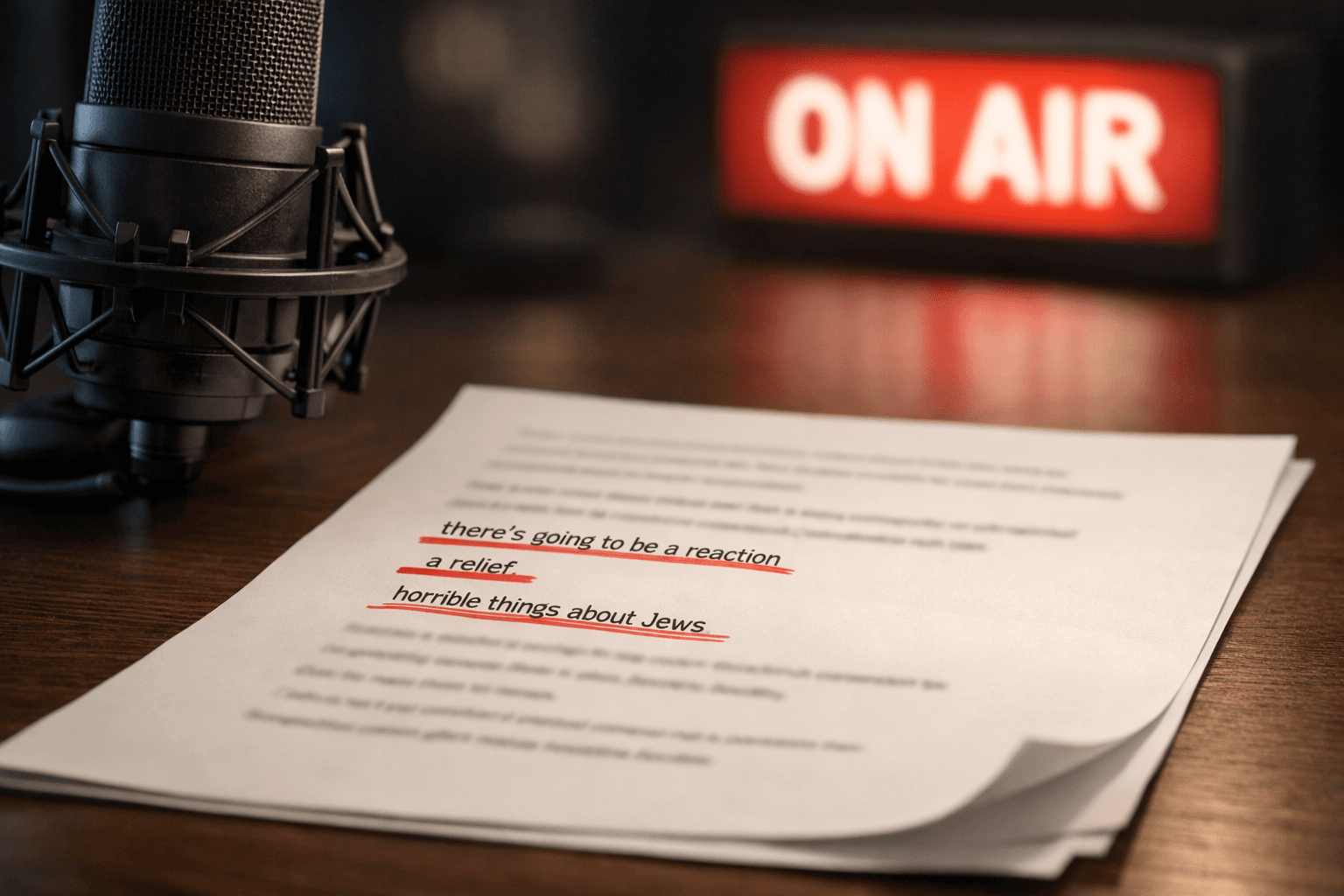
Presented that way, the backlash starts to sound excusable. Gold says ‘there’s going to be a reaction’, and he calls it ‘a relief’ when people can finally say ‘the most horrific things’, including ‘horrible things about Jews’. He treats grievance as legitimate, backlash as inevitable, and antisemitism as one of the things that follows.
It also points straight to the next move. If the common belief is that whites are being shamed and blocked from opportunity, it is a short step to the suggestion that they are being displaced, and then to the question of who is doing the displacing. Conspiracy stories are a ready-made answer, and in the far-right repertoire Jews keep appearing as the alleged planners, funders, or hidden coordinators. The ‘Great Replacement’ theory regularly takes that form, linking demographic change and immigration to Jews and Jewish organisations. ‘Cultural Marxism’ plays a similar role as a catch-all explanation for social change, with a long history as a far-right trope with antisemitic associations, even when it is used carelessly.
This is why inflated stories of white victimhood are not harmless even when they sound like empathy. They turn a vague sense of loss into a search for culprits. Jews tend to appear on it because antisemitism already comes with a ready-made explanation for why ‘things go wrong’.
The IHRA working definition puts it: antisemitism ‘frequently charges Jews with conspiring to harm humanity, and it is often used to blame Jews for “why things go wrong”’
AmericaFest itself offers an example of the move from white grievance to a hierarchy of racism that puts white people at the top. In December 2025, Tucker Carlson told the crowd that bias against white men was ‘precisely as bad as antisemitism’, but ‘much more widespread’ and ‘much more damaging’.
That is the destination of Gold’s ‘objective climate’ talk. If you convince people they are the targets, you make them receptive to arguments that are toxic. Antisemitism becomes one more special pleading minority complaint, rather than a long-running pattern with its own history.
A more responsible version of Gold’s point would keep two thoughts in the reader’s head at the same time.
First: Yes, the fear of losing respect and standing is real, and online politics often rewards people for feeling humiliated and angry.
Second: treating white grievance as an accurate description of social conditions is how you turn this unease into scapegoating, because the question ‘who did this to us’ always wants a face.
Conspiracy politics already carries an old template: hidden elites, media control, finance, NGOs. Jews are the ready-made suspect in that template.