Why we need more research on how Anglo-Jewry profited from slavery

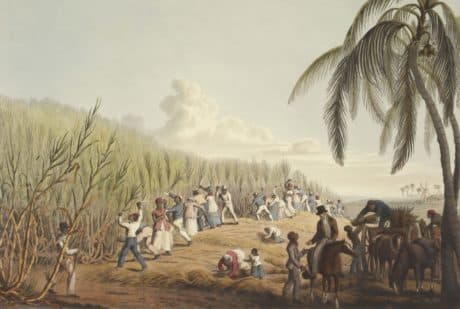
Jews were not overrpresented in the slave trade but we still have a difficult history to confront. Nathan and Jonathan Abrams call for more research to assess Anglo-Jewry's legacy of slavery.
The database of the Centre for the Study of the Legacies of British Slave-ownership makes interesting reading and some of it is not so comfortable for England’s Jews.
It reveals the extent to which Anglo-Jewry was involved in the transatlantic slave trade, that colonial slavery helped to shape modern Anglo-Jewry and that England’s Jews still live with its legacies.
In London, Jews were able to invest in the companies that conducted the transatlantic slave trade from the 1660s onwards. In other port cities, such as Bristol and Liverpool, the profits and products of slavery touched all their inhabitants, including Jews, who were attracted there because of the mercantile opportunities they offered.
In fact, the impact of slavery infused the entire British way of life. As the UCL website states, ‘colonial slavery shaped modern Britain and we all still live with its legacies. The slave-owners were one very important means by which the fruits of slavery were transmitted to metropolitan Britain.’
But where much research has been done on Jewish role in the transatlantic slave trade with respect to the Netherlands and the United States, less is known about the role of Anglo-Jewry, and its effects, in Britain’s overseas colonies.
This is where the database is enlightening.
Take this sample entry, for instance: Abraham Aguilar of Devonshire Square. Aguilar, according to the database, was a ‘Slave-owner in Jamaica, in London when he made his will in 1794 and dying there later the same year. His will places him in a transatlantic network of Jewish merchants and slave-owners currently or previously of Jamaica.’
Aguilar’s will states that he bequeathed 'all his "negro and other slaves" and the increase of the female enslaved people' to his wife Judith, although how many souls this amounted to is unknown.
Brothers Jacob and Joseph Barrow were merchants in Bridgetown and London who were also engaged in the slave trade. They were connected to the Baruch-Lousada and Montefiore families who settled in various parts of the Caribbean, as well as Britain.
Significantly, Jacob Barrow 'left monetary legacies to Jewish institutions in London’. A clue to what those institutions might be is provided in the will of slaveowner Ellis Wolfe.
‘I give and bequeath unto the Treasurers and Wardens for the time being of the following Synagogues [that is to say] the Hambro Synagogue in Church Row Fenchurch street the Great Synagogue in St James Duke Place the New Synagogue Bricklayers Hall in Leadenhall Street all three in the City of London and the English and German Jews Synagogue.’
He also left numerous benevolent bequests many of which benefitted the Jewish community in London, including the Jews Hospital in Mile End and a Jewish Free School.
Nathan Mayer Rothschild, of the famous banking dynasty, according to the database, had ‘158 enslaved’, although the precise nature of his involvement in slavery remains contested -- not least because the commission rejected a claim for compensation three years after his death in 1836, presumably because the claim related to a mortgage he had held rather than to slaves he owned personally. One of the ways he had benefited from slavery was by mortgaging 88 slaves in Antigua. When the debtor - who had put up the slaves as collateral - defaulted, Rothschild sought to recoup the £3,000 he was owed through a compensation scheme he had helped the government to set up to bail out slave owners after the abolition of slavery in 1835.
Rothschild and his brother-in-law Sir Moses Montefiore arranged £15 million of the £20 million government loan that financed the slaveowner compensation process that British taxpayers only finished paying off in 2015. None of this went to the victims of slavery, but more work needs to be done to establish how far those involved in arranging it (at a rate of return almost half that normally paid on government loans) benefitted from their involvement – particularly given the close ties of business and friendship that linked Rothschild and Montefiore with leading anti-slavery campaigners like Thomas Fowell Buxton and the Gurneys.
The Rothschilds, of course, funded a series of Jewish institutions, including our alma mater, the Jews’ Free School (later the Jewish Free School or JFS). As David Harris has written, ‘You can’t tell the history of JFS without mentioning the Rothschilds for whom JFS was a favourite charity. The family’s support of and involvement in the school was- and remains to this day-more than considerable and in “Children of the Ghetto”, Zangwill tells us that “Rothschild was a magic name in the ghetto” and “It stood next to the Almighty’s “as… a friend of the poor”’. As things currently stand, it does not look as if this particular Jewish institution was funded through the proceeds of slavery during this later phase of its existence – but of course JFS was founded in 1732 (long before Nathan Rothschild came to Britain), and more work needs to be done on the involvement of other Jewish institutions and community charities in slavery, particularly those associated with the Sephardic-Atlantic world such as Bevis Marks.
But this must be qualified by the fact that £3,000 was probably paltry given the range and extent of the Rothschilds’ diverse portfolio and philanthropic endeavours although the Rothschilds did have other slave owning interests according to the UCL database.
Nevertheless, we can infer from this that key Anglo-Jewish institutions benefited from slavery and that these institutions are probably, in many cases, still in existence.
Jews were not over-represented in the slave trade. Rather, the Jewish involvement in slavery was not disproportionate to its numbers and hence was relatively quite small. In his book on the participation of Jews in the slave trade and slavery, Eli Faber, author of Jews, Slaves, and the Slave Trade: Setting the Record Straight, has established that Jews played a tiny role in the slave trade. As slave owners, they owned a fraction of slaves on average compared to their non-Jewish peers.
Faber explained: 'Overwhelmingly, Jewish merchants and shippers were not involved at all; they represent a minuscule portion of owners of ships'. While Jews did own slaves, he found, 'their ownership was directly proportionate to their numbers'. Only a handful of Jews were among the owners of The Royal Africa Company and the South Sea Company, the two companies with slaving ventures. Having said that, 'those Jews were more likely than non-Jews to invest heavily'.
There seems to be an element of self-exculpation in all this to exonerate charges that Jews ‘controlled’ the transatlantic slave trade, an antisemitic conspiracy theory championed by Louis Farrakhan and the Nation of Islam among others.
But the involvement of Jews in both the UK and around the world is clear and the wider Jewish community in England certainly benefited from it.
Another question is what did the rabbinic authorities make of all this? In the United States, more than one prominent rabbi defended slavery using biblical justifications, although this view was by no means widely shared.
What the views of Anglo-Jewry and its rabbinate were, however, is less well known.
A hint is provided by Rabbi Morris Jacob Raphall who, for some time, was honorary secretary to Solomon Herschell, chief rabbi of Great Britain (1802-1842). Rabbi Raphall was an 'outspoken proponent of slavery', which he endorsed slavery as a morally correct institution, sanctioned by the bible, and therefore Judaism.
This evidence of the Jewish debt to slavery only scratches the surface and further research is required to uncover the extent to which the proceeds of slavery benefited Jewish institutionsas a that survive today.
But until that research is complete and there is a reconciliation, our community will not have begun to absolve itself of the shameful part it played in a historic crime.
The authors would like to thank Professor Abigail Green for her input into an updated version of this article.