
Short Story: The Borrowed Daughter

-1.jpg&w=3840&q=75)
The Borrowed Daughter
Once a month, I spent a day with Hilda.
‘Because,’ said my mother, parking on the drive, ‘she’s got three grown-up boys and no daughter so she likes to spend time with you.’
‘I see.’
The forty minute drive transported me from an immaculate world where my mother wiped the surfaces clean and didn’t leave as much as a spoon out of place to one of chaos and turmoil: piles of unfolded laundry; dead flowers left in vases and carpets covered in dog-hair, yet strangely a place of serenity. A place where I felt happy.
I hopped eagerly out of the car and when Mum saw the front door open, she waved and drove away as she always did. I hoped that she was more relaxed when I wasn’t there. She always seemed so on edge.
Going to Hilda’s house was like stepping into a world of joy. It was a welcome break from Mum and Dad’s arguments and I was treated as if I were a blessing. Much older than my mum, Hilda wore floral dresses, her grey hair in a bun or plaited and wound around her forehead and she always had a benign, contented smile, embracing me warmly when I arrived.
We picked posies of wild flowers from her ramshackle garden where rusty old wheelbarrows and tools stood abandoned amongst a froth of buttercups and cow parsley, and tied them with ribbon. We baked fairy cakes in her chaotic kitchen where dirty plates lay soaking like drowning vessels in soapy water and laundry was piled high on a chair, waiting patiently to be sorted. While the cakes cooled, she read me stories: Anne of Green Gables, Little House on the Prairie, Ballet Shoes as if she was enhancing my young life in order, retrospectively, to improve hers. She’d mentioned once that her own childhood hadn’t been ideal, being sent away to boarding school at the age of seven and rarely seeing her parents who were distant, not only geographically, but also in manner.
We snuggled up together on the settee in her living room like taking refuge in a lifeboat away from the wreckage around us: sheets of scores having slipped off a music stand, unwatered plants, pictures on the walls all skew and anything made of material, threadbare. But in spite of the chaos, Hilda made time and space for me, as if I deserved the very best. My mother was loving in a distracted way, always doing something else, talking on the phone, her eyes darting around and suspicious of my father who was always busy with work, and aloof.
Hilda, on the other hand, gave me her undivided attention and I liked to nestle my body against hers. She was warm and slightly overweight, a pretty face, sweet pink cheeks and lips; almost girlish, as if her slightly naïve view of her life was reflected in her complexion. There was definitely something youthful about her even though, to my mind, she was quite old. She often laughed out loud, tilting her head back when I said something funny and then you could see her many chins topping a white neck and her grey hair falling out of place. She cuddled me not out of duty but as if she genuinely loved me.
When the cakes had cooled, we iced them until they shone like snow. Hilda had a variety of decorations to go on top: coloured sugar roses, silver and gold balls that looked like bullets but were edible, chocolate curls that resembled pencil shavings. We piled the dressed cakes carefully in tins, lined with kitchen towel, proof of our industry.
And then there was something else.
Among the secular pleasures, she dropped in Jewish ones as if introducing me gradually to a religion which I’d no knowledge of.
One month, we baked challah, kneading the white dough and plaiting it into shape. When it emerged from the oven, glazed and varnished, the kitchen was filled with the smells of egg and dough. We ripped a piece each: still warm. It melted in my mouth as if welcoming me.
Hilda taught me the Hebrew alphabet a letter at a time. It was confusing: the shapes were unfamiliar to me and the reading we later did seemed the wrong way round. We used the books that she’d taught her sons with, the pages now slightly curled and yellowing, but we made good progress. She introduced me to the fiction of Isaac Bashevis Singer, his stories of the fools of Chelm and his other tales: a woman with a beard was one I especially enjoyed. Sometimes Hilda put music on her old record player and she told me it was called klezmer. She couldn’t help but stand up and dance when the music started and, after an initial shyness, I joined her.
She taught me some Hebrew songs: Havah Nagillah and David, Melech Yisrael, and when my grasp of the language became stronger, she taught me prayers.
It seemed to me that Judaism was a happy, celebratory religion (she told me nothing of our painful history, which I discovered later) and, I wondered why, if this was the case, Hilda was the only person I knew who was immersed in it. Surely everyone should be?
Only years later, Mum told me how she and Hilda had met. The women seemed so different, my mother nervous and uptight, always running late, and Hilda, plump and smiling, her dresses brightly coloured. They’d both previously worked in an adult education college, against which both of them railed (the lack of organisation, the bureaucracy, the dogmatic management) although neither of them taught: Hilda supported the difficult kids who truanted and played up; my mother ran the office. They became friends although it seemed to me a surprising relationship: Hilda soft and relaxed, and my mother, distracted and bothered. They couldn’t have looked more different either, Hilda, short, plump and feathery as a dove, my mother tall and thin, her hair pulled into a tight ponytail, and a fixed stare upon her face. Whereas Hilda’s skin was flushed and freckled, my mother’s was white as marble, high cheekbones carved from stone. She was a dutiful mother, making sure that I was well-fed and that my clothes were washed and fresh but she wasn’t very warm, as if it was all rather a chore, similar to the work she was paid to do.
The women started going out together after work, for drinks at the wine bar or visits to the theatre. Over time they unfolded themselves to each other like flowers opening their petals wide to reveal the dark centre within. My mum, Marion, discovered that Hilda was happy with her husband, Simon, like her, chubby and easy-going and their three tall, sporty boys, teenagers now, but that they’d sadly lost a baby girl. She’d had meningitis and died at three months. I was shocked when Mum first told me this. They seemed such a joyful family and I didn’t associate them with loss and sadness.
That was more the mood of my family although they’d less obvious reason to be morose. Ever since I could remember there’d been tension between my parents. Dad left a couple of times but then returned. I’d the feeling that he’d found someone else but I was never actually told that. Each time Dad was absent, it felt better in a way as the house was calmer and Mum was happier but it also felt as if something was missing, a jigsaw with lost pieces: his mug, chair, his side of the bed unused.
I’d no idea why they were together. They seemed to have nothing in common but they hung onto the marriage like two people clinging to the same raft.
At lunchtime, Hilda and I sat at her kitchen table. She swept to one side the unopened post, old newspapers and shopping receipts with her arm, like a train forcing its way through thick woodland. On our plates, blue and white floral, she’d placed cheese and cucumber sandwiches. Hers were just cut in two but mine were round, shaped with biscuit cutters as if food for a doll, laid upon lettuce leaves like two tiny boats on a wrinkled sea and little cherry tomatoes and carrot sticks lay at the side as if nothing was too much trouble as far as I was concerned. She had water; I had apple juice. Afterwards she had an orange but she’d arranged strawberries and raspberries on my plate as if I were a princess. Was this love? That was how it felt to me, not only the treats but the way she watched me as I ate, ready to provide in case I wanted anything.
After lunch, she took out the flower press, a rectangular wooden box where blotting paper and cardboard layers alternated, weighed down with butterfly screws at each corner. When we opened it, we uncovered the flowers we’d pressed the previous time: honeysuckle now papery and thin as moth wings, geranium petals retaining some faded redness but not their bulk, and daisies, their white petals flat and lifeless. It was fun to make cards, though. Using tweezers, we lifted the petals and glued them to stiff paper to use for future birthdays. When they dried, they looked attractive although you could still see the blob of glue, varnished and hard.
When my mother collected me, I came out to the car carefully carrying my spoils: pressed flower cards, posies of flowers, the ribbon still wet from where it had hung in the water and iced cakes in a tin but never the Jewish items as if they were a secret. The bagels, the teiglach, the latkes were left behind. I waved from the car, Hilda waved back and then disappeared. My mother viewed my treasures with encouraging noises, ‘Gosh! What did you make today, darling?’ but there was something else there as if she was both resentful and grateful at the same time.
She always made me send a thank you note to Hilda. Mum was all about doing the right thing. I used one of the cards we’d made. A day on, the honeysuckle bloom was well and truly flat and the glue had dried, holding the flower in its glossy grip.
When young, I accepted these visits as the norm but then, as I grew older, I started to ask questions. After all, none of my friends spent the day with old ladies.
‘Mum,’ I said, when she picked me up one day, ‘I really like Hilda but why do I go there for visits?’
‘I told you she has grown up sons and no daughter. She enjoys your company.’
‘And I like hers. But why the Jewish things? Is she Jewish? Am I?’
Mum fell silent. Sometimes I found the car was the best place to speak to her. Maybe looking ahead when we spoke helped as we could avoid eye contact.
‘She is.’
‘And are you?’
My mum’s face flushed.
‘It’s complicated, Evie.’
‘Will you tell me? Please?’
When we reached home she parked on the drive. Even though we were stationary she still stared ahead.
‘You deserve to know the truth, Evie. I should have told you long ago.’ She paused as if searching for the right words. ‘I’m Jewish but Granny and Grandad didn’t practise Judaism at home as they’d suffered because of it.’
That was a shock. Being Jewish, as Hilda presented it, appeared delightful. Why would you suffer because of it? But I didn’t ask. I didn’t want to stem Mum’s flow.
‘Daddy’s very against religion, as you know, so I haven’t brought you up with a Jewish tradition. I’ve always regretted that, like I let you down. When I met Hilda and we became friends, she told me that she was Jewish and I told her that I was too. It seemed to me the perfect solution that you could be like a borrowed daughter for her and you could learn about your heritage at the same time.’
‘I see. Don’t you want to join in with us?’
‘No,’ said Mum. ‘Daddy wouldn’t like it and nor would Granny and Grandad.’
There was pain etched on her face, as if this was the best solution but it didn’t mean it was resolved.
The monthly visits went on for years but whereas I changed – the pretty dresses replaced by tight jeans and cropped tops; several hoops in each ear; make-up heavily applied – the activities didn’t. Hilda was clearly aging, wrinkles around her eyes ‘because I’ve laughed a lot,’ she explained when she saw me looking at them.
But she still treated me like a little girl, as if I’d moved on but she hadn’t. It was as if I’d jumped on a bus but she was still waiting for me at the stop.
Aged fourteen, I no longer wanted to pick flowers from her garden to tie with rafia or bake cakes with shiny icing. Her notion of a daughter was a limited, old-fashioned one whereas my mum accepted that I was a teenager and let me be one. I was allowed to do as I pleased apart from one thing: when I started saying that I didn’t want to go to Hilda’s any longer, my mum was uncharacteristically firm: ‘Please, Evie, it means the world to her. She’d be so upset if you stopped the visits and it isn’t even that often.’
So I still went but I became more questioning. Why had she and Mum ended their friendship? What did Mum feel about it all? Did she want me to have these days or not? I sensed her ambivalence towards Hilda, towards Judaism, maybe even towards me as if she, herself, was still grappling with it all.
After all these years, my knowledge of Hebrew was pretty good. I’d eaten a lot of Jewish food: latkes, their oil seeping into the kitchen towel beneath; chopped liver which Hilda decorated with grated egg and I knew songs, stories, how to sing the brachot on shabbat although I’d never actually sung them on a Friday night. We read the psalms together and she taught me some tunes.
Aged sixteen, I decided to take a firm hand. I was starting in the sixth form and I was going out with Tom. Hilda was clearly out of breath much of the time and struggling and the time came to end it. In spite of Mum’s protestations, I made a decision to stop going.
I didn’t see Hilda much for a while.
A few years later, Hilda died. I felt bad that I hadn’t visited her as often as I should have. When Mum told me that she’d passed away, I felt guilty that I’d neglected her but grateful for all that she’d done for me.
She left me all her Judaica: silver candle sticks, her kiddush cup, her recipes, her klezmer records and her Hebrew books of letters, and fiction too, Isaac Bashevis Singer, the fools of Chelm.
Now I have daughters of my own and I’ve passed onto them the sense of Jewish identity that Hilda gave me. We use the same candlesticks and recipes that she bestowed on me.
My father’s passed away and when my mum comes to see me and my girls, she joins in with challah baking, and we always sing the brachot on shabbat, tentatively, as if she wants to but is unsure, having little knowledge herself. Since retiring and becoming a grandmother she’s thawed slightly and I wonder if Hilda had somehow brought my mum and me closer.
Hilda, my mum, me, my girls: all connected by more than we could fathom.
Hilda felt grateful that my mother had lent me to her.
It took me years to appreciate that in fact Hilda had been lent to me.
And that the Judaism that she taught us would outlive us all.
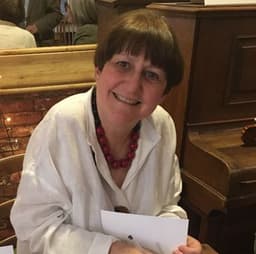
Tamar Hodes, Israeli born, is a Jewish writer living in the UK. Her three published novels are Raffy’s Shapes, The Water and the Wine and Mixed which was longlisted for the Comedy Women in Print awards. Many of her stories have been broadcast on radio and included in anthologies such as A Treasury of Jewish Stories and Salt’s Best British Stories.